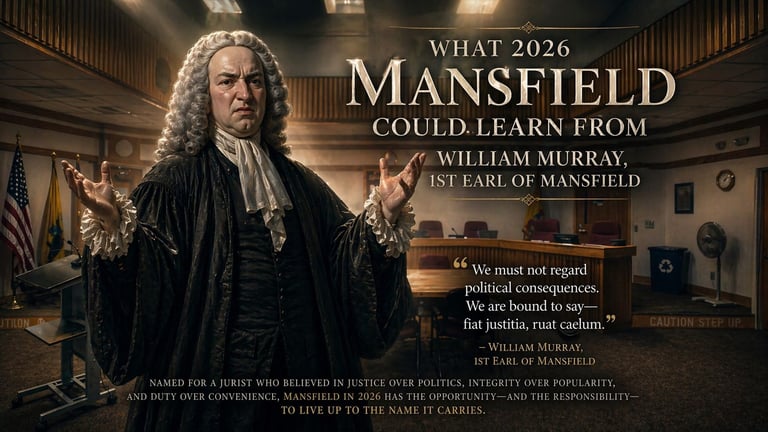
What 2026 Mansfield Could Learn From William Murray, 1st Earl of Mansfield
"The law must be respectable to be respected. Authority alone is not enough. If the public sees inconsistency, selective enforcement, or rules that feel disconnected from common sense, trust erodes quickly. Once that trust is gone, no amount of procedure can restore it."
OPINIONEDITORIAL
Michael Bollard
4/25/20262 min read
The Township of Mansfield carries a name with weight behind it. William Murray, 1st Earl of Mansfield was not a politician in the modern sense, but a jurist. A lawyer. A decision-maker whose role was not to follow the moment, but to interpret the law with clarity, restraint, and an eye toward justice. That distinction matters more than ever.
Murray believed that the law was not a tool to be bent by convenience or public pressure. It was a framework that demanded discipline from those entrusted to apply it. In one of his most telling principles, he made it clear that political consequences should not influence judgment. That idea stands in sharp contrast to how government often operates today, where decisions can be shaped by optics, pressure, or the path of least resistance.
Local government is not immune to that drift. In fact, it is where it matters most. At the municipal level, decisions are closer to the people, less abstract, and more immediate in their impact. That makes integrity not just important, but essential. When residents show up, speak out, or raise concerns, they are not looking for technical compliance. They are looking for fairness. They are looking for judgment. They are looking for someone willing to do what is right, even when it is inconvenient.
Murray also understood something else that is often overlooked: the law must be respectable to be respected. Authority alone is not enough. If the public sees inconsistency, selective enforcement, or rules that feel disconnected from common sense, trust erodes quickly. Once that trust is gone, no amount of procedure can restore it.
That is where the lesson becomes practical. The idea of an ethics ordinance is not about adding layers of bureaucracy or creating new hurdles. It is about reinforcing a standard. It is about making clear that public officials are expected to act with transparency, accountability, and consistency. It is about ensuring that decisions are made on principle, not preference.
There is also a quieter lesson in Murray’s legacy. He did not chase popularity. He understood that public confidence follows from sound decisions, not the other way around. That is a difficult standard to hold, especially in a time when every action is scrutinized and every decision is subject to immediate reaction. But it is the standard that builds lasting trust.
Mansfield in 2026 does not need to replicate 18th-century England to benefit from these ideas. It only needs to recognize that good governance has always depended on the same core principles: act with integrity, apply the law consistently, and prioritize what is right over what is easy.
The name “Mansfield” is more than a label on a map. It is a reminder. The question is whether that reminder still carries meaning today.
- Michael Bollard, Committeeman of Mansfield Township