
The Illusion of Neutrality in Local Politics
A closer look at Mansfield's "Unbiased" political stance.
OPINIONEDITORIAL
Michael Bollard
4/28/20262 min read
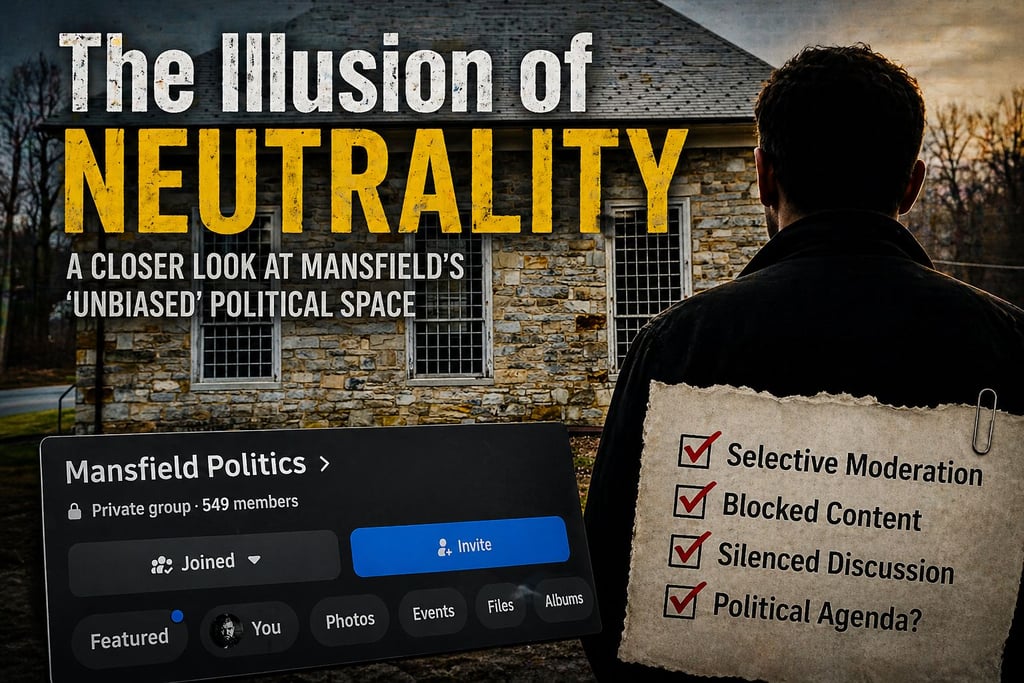
In Mansfield, much of the public conversation now happens online. Local Facebook groups have become the go-to space for residents to discuss issues, ask questions, and stay informed. When a group presents itself as neutral or community-driven, people naturally assume the discussion inside reflects a fair and open exchange of ideas.
That assumption deserves a bit more scrutiny.
The “Mansfield Politics” Facebook group is one of the more visible platforms for local discussion. On the surface, it appears to function as a community forum. In practice, the way content is managed raises questions about how open that forum actually is. There have been repeated instances where posts are blocked or allowed only with comments disabled. These actions have not been applied evenly across all topics, which suggests that moderation is not simply about maintaining order, but also about shaping the conversation.
Moderation is expected in any online group. The issue arises when a platform that limits discussion in this way continues to present itself as neutral. When residents believe they are seeing a full exchange of ideas, but key responses are restricted or prevented, the result is not just moderated discussion, it is filtered discussion.
The role of the group’s administrator adds to this concern. The page is run by Michael Misertino, a former township committeeman who remains active in local affairs. Public participation, including attending meetings and speaking during public comment, is a normal and healthy part of local government. However, when that involvement is combined with control over a widely used communication platform, the line between moderator and participant becomes less clear.
At township meetings, there have been multiple instances of extended public comment directed at statements made from the dais, including criticism tied to interactions with former Committeewoman Desiree Mora Dillon. Attendance has also been selective, with re-engagement during discussions tied to specific issues, including Ordinance 2018-02.
Outside of meetings, there has been clear support for Brent Connelly, including door-to-door efforts encouraging residents to display campaign signs. Supporting a candidate is entirely appropriate. The concern is how that support intersects with control over a platform that many residents rely on for information.
When advocacy and platform control exist together, the platform’s role changes. It is no longer just a forum. It becomes a gatekeeper. What gets posted, what gets discussed, and what gets limited all influence how residents understand local issues and candidates.
This is especially relevant in the context of ongoing discussions about transparency in Mansfield. Ordinance 2018-02, which governs the use of recording devices during public meetings, has already prompted debate about access to information . That same principle applies outside of official meetings. Residents rely on informal platforms to stay informed, and the expectations of openness should follow.
A platform that filters discussion while presenting itself as neutral creates a gap between perception and reality. Residents may believe they are seeing the full conversation when, in fact, they are seeing a curated version of it.
There is nothing wrong with having a viewpoint or supporting a candidate. The issue is clarity. If a platform is moderated in a way that favors certain perspectives or limits others, it should not be presented as an open forum.
The strength of local discourse depends on transparency, not just in government, but in the spaces where residents engage with one another.
- Michael Bollard, Committeeman for Mansfield Township (Warren County)